Top Conversational AI Platforms in 2026-27
 By
Avantika Shergil
|
Jul 6, 2026 |
Artificial Intelligence
By
Avantika Shergil
|
Jul 6, 2026 |
Artificial Intelligence
Conversational AI has gone from being a new idea to a game-changing tool for enterprises all around the globe. New technologies like ChatGPT have sped up this change by providing solutions that range from creating content to automating customer assistance. According to Statista, the worldwide chatbot business will be worth $1.25 billion by 2025. This shows how much more people are relying on conversational AI to make their experiences better.
Search Engine Journal did a survey that indicated that 40% of people like talking to chatbots when they connect with companies. These systems provide immediate, tailored help, which makes operations easier and increases client satisfaction. Conversational AI uses both Natural Language Processing (NLP) and Machine Learning (ML) to do things that regular chatbots can’t. It changes customer service, virtual help, and more.
This article looks at the best conversational AI platforms of 2026-27, talking about what makes them different, what they can do, and how they may be used. This article gives companies the information they need to make smart choices and use AI to their advantage. It compares conversational AI to conventional chatbots and lists the most important factors to consider when choosing the proper platform.
Table of Contents
What Are Conversational AI Platforms?
Conversational AI platforms are smart software systems that help businesses create and manage virtual agents like chatbots, voice bots, and digital assistants. These platforms make it easier to design conversations, train AI on real-world language, and deploy solutions across multiple channels.
The goal is simple deliver fast, accurate, and human-like support anytime and anywhere.
With these tools, businesses can build multilingual bots, test and refine how they respond, and use built-in analytics to improve performance. Many platforms also support automation in sales and service, helping companies scale their operations and boost revenue.
In short, these platforms make AI-powered communication more accessible and effective.
Benefits of Implementing Conversational AI
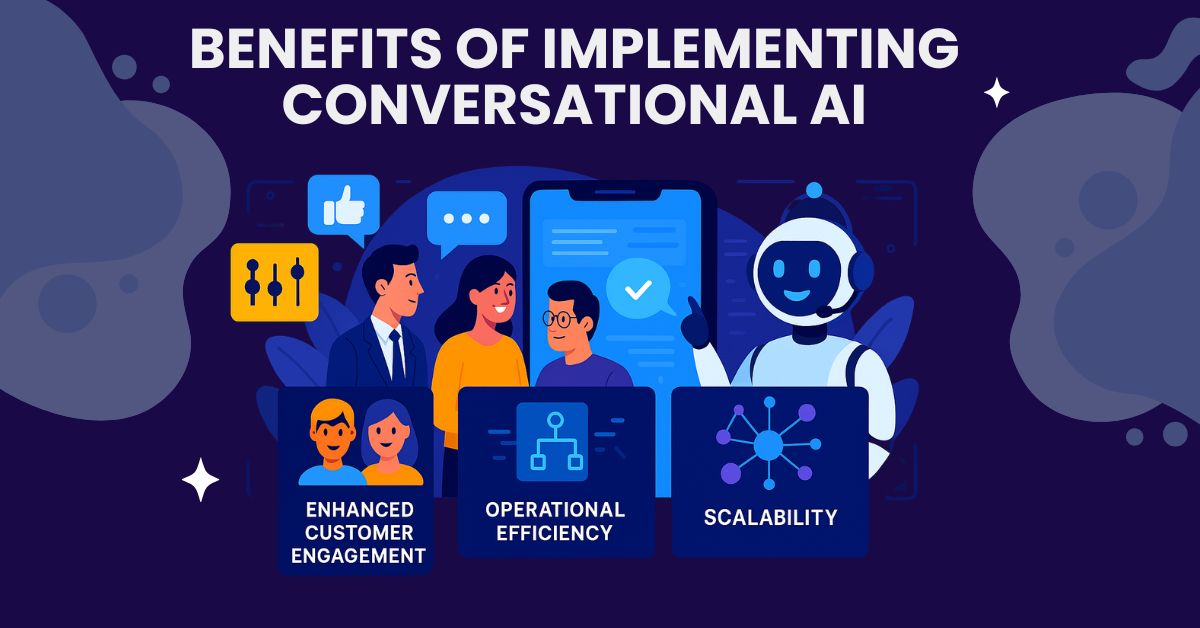
AI-powered chatbots use data analytics to make conversations more personal, which boosts conversions. It also scales up easily at busy times, so service is always the same. Multilingual support helps you reach more people across the world, while sentiment analysis helps you learn more about your customers. Conversational AI takes care of FAQs and transactions, freeing up human agents to deal with more complicated problems. This increases productivity and helps businesses thrive.
Enhanced Customer Engagement
Conversational AI enables businesses to create fast, personalized, and engaging interactions. Unlike basic chatbots, these systems can understand user intent, context, and preferences, making every conversation feel more natural and meaningful.
Customers are more likely to stay engaged when they feel understood. AI systems analyze past interactions to offer personalized responses, such as suggesting products based on previous purchases. This not only improves user satisfaction but also drives higher conversion rates.
One major benefit is 24/7 availability. Customers can get support anytime without waiting for office hours. Plus, whether the conversation happens on a website, mobile app, or social media, the experience remains consistent.
Multilingual support also allows businesses to reach a global audience, while sentiment analysis tools provide insight into how customers feel during interactions.
Key takeaway: With better engagement, businesses build stronger relationships, improve retention, and increase long-term loyalty.
Operational Efficiency
Conversational AI significantly improves how businesses manage day-to-day operations. It automates repetitive tasks like FAQs, order tracking, or account updates, freeing up human agents to handle more complex or high-value issues.
By reducing manual work, companies can lower labor costs and improve overall productivity. Response times are also much faster. AI tools instantly address common questions, reducing wait times and keeping customers happy.
These systems integrate easily with CRMs, support platforms, and internal databases. This means they can fetch data, log issues, or even initiate transactions without manual effort.
Example: A telecom company using conversational AI can resolve up to 80% of customer queries without human involvement.
Key takeaway: Streamlining support with AI improves service speed, reduces costs, and lets human teams focus on strategy and innovation.
Scalability
One of the standout benefits of conversational AI is its ability to scale effortlessly. Whether you’re handling hundreds or millions of conversations, AI systems can manage the load without compromising on quality.
During peak seasons or sudden spikes in demand, AI tools maintain consistent performance. They don’t slow down, take breaks, or get overwhelmed like human agents. This is especially useful for industries like e-commerce, where traffic can surge during events like holiday sales.
Conversational AI also adapts to the size of your business. Startups and global enterprises alike can use the same platform, scaling up features and capabilities as needed.
Example: An online store can use AI to manage Black Friday traffic, answering thousands of customer questions in real time.
Key takeaway: Scalability allows businesses to grow without increasing operational stress, ensuring reliable service, no matter the volume.
Read: Predictive Analytics in Mobile Apps: The Comprehensive Guide
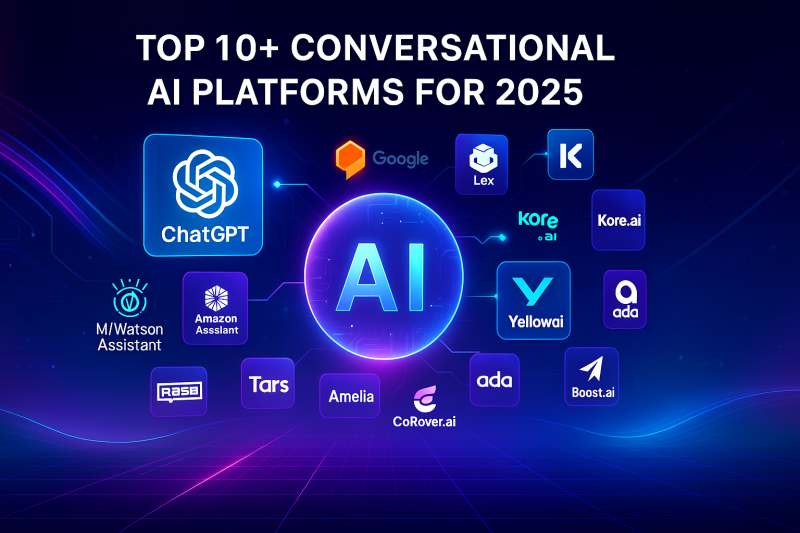
Top Conversational AI Platforms for 2026-2027
Aisera
Aisera is a leading conversational AI platform designed to automate enterprise service management, customer support, IT operations, and employee experiences. Powered by generative AI, large language models (LLMs), and AI agents, it helps organizations resolve requests through natural, human-like conversations across multiple channels. The platform combines conversational automation with workflow orchestration, enabling businesses to improve productivity while reducing operational costs. As one of the more advanced conversational AI platforms, Aisera integrates seamlessly with enterprise applications to deliver personalized and context-aware interactions. Its enterprise-grade security, scalability, and automation capabilities make it a preferred AI conversational platform for large organizations.
Key Features
- Generative AI-powered virtual agents for customer and employee support
- Enterprise search with conversational knowledge retrieval
- Workflow automation across IT, HR, customer service, and operations
- Omnichannel support for web, mobile, chat, email, and collaboration platforms
- Integrations with ServiceNow, Salesforce, Microsoft Teams, Slack, Zendesk, and other enterprise systems
Why It Stands Out
Aisera goes beyond traditional chatbot functionality by combining conversational intelligence with enterprise automation. Its AI agents understand user intent, automate repetitive workflows, and continuously improve through machine learning. Unlike many conversational AI tools, the platform is purpose-built for enterprise environments where security, governance, and compliance are essential. Businesses looking for scalable conversational AI software that supports both customer-facing and internal use cases will find Aisera to be a comprehensive conversational artificial intelligence platform.
Ideal Use Cases
- Enterprise IT service desk automation
- HR employee self-service assistants
- Customer support automation
- Knowledge management and enterprise search
Botpress
Botpress is an open and highly customizable conversational AI platform that enables developers and businesses to build AI-powered chatbots and virtual assistants using modern large language models. The platform combines visual conversation design with advanced AI capabilities, allowing teams to create sophisticated conversational experiences without building everything from scratch. It supports multiple LLM providers, giving organizations flexibility when selecting AI models. As one of the fastest-growing conversational AI platform providers, Botpress is suitable for startups, enterprises, and agencies developing intelligent conversational AI apps. Its extensibility makes it a popular choice for organizations seeking flexible conversational application platform solutions.
Key Features
- Visual conversation builder with drag-and-drop workflows
- Support for OpenAI, Anthropic, Google Gemini, and other LLMs
- Built-in knowledge base and Retrieval-Augmented Generation (RAG)
- API-first architecture with extensive customization options
- Multi-channel deployment across websites, messaging apps, and custom applications
Why It Stands Out
Botpress offers an excellent balance between developer flexibility and low-code simplicity. Unlike many closed conversational AI systems, it allows organizations to customize nearly every aspect of chatbot behavior and integrations. The platform supports advanced AI agents capable of retrieving company knowledge, executing workflows, and interacting with external APIs. For businesses seeking scalable conversational AI platform software with modern generative AI capabilities, Botpress is among the strongest options available.
Ideal Use Cases
- AI-powered customer support chatbots
- Enterprise knowledge assistants
- SaaS product support bots
- Custom AI applications with LLM integration
Cognigy
Cognigy is an enterprise-grade conversational AI platform that helps businesses automate customer service through AI-powered voice and chat agents. Designed for complex enterprise environments, it enables organizations to build intelligent virtual assistants capable of delivering personalized conversations across digital and voice channels. The platform combines conversational AI, workflow automation, and analytics to improve customer experiences while reducing support costs. As one of the leading conversational AI companies, Cognigy is widely adopted across industries including banking, telecommunications, retail, and healthcare. Its scalable architecture makes it a trusted conversational AI software solution for global enterprises.
Key Features
- AI-powered voice and chat automation
- Low-code conversation design studio
- Omnichannel deployment across web, mobile, messaging apps, and contact centers
- Enterprise integrations with CRM, ERP, and contact center platforms
- Real-time analytics and conversation optimization
Why It Stands Out
Cognigy excels in delivering enterprise-ready conversational experiences that integrate seamlessly into existing business systems. Its combination of generative AI, automation, and workflow management enables organizations to resolve customer inquiries efficiently while maintaining a natural conversational flow. Unlike many standalone conversational AI tools, Cognigy emphasizes enterprise scalability, governance, and security. This makes it an ideal AI conversational platform for organizations handling large customer interaction volumes.
Ideal Use Cases
- Contact center automation
- AI voice assistants
- Banking and financial customer support
- Omnichannel customer engagement
Drift
Drift is a sales-focused conversational AI platform that helps businesses engage website visitors, qualify leads, and accelerate revenue generation through AI-powered conversations. Rather than relying on static contact forms, Drift enables organizations to interact with prospects in real time using intelligent chatbots and conversational marketing workflows. The platform integrates with leading CRM and marketing automation systems to streamline the buyer journey. As one of the most recognized conversational AI platforms for B2B sales, Drift combines conversational intelligence with account-based marketing strategies. Its automation capabilities make it a valuable conversational AI software solution for sales-driven organizations.
Key Features
- AI-powered lead qualification and routing
- Real-time website chat with intelligent automation
- CRM integrations with Salesforce, HubSpot, and Microsoft Dynamics
- Meeting scheduling and sales automation
- Conversation analytics and reporting
Why It Stands Out
Drift specializes in conversational marketing rather than general customer support, helping businesses convert anonymous website visitors into qualified sales opportunities. Its AI-driven conversations shorten response times and improve engagement throughout the sales funnel. Compared with traditional conversational AI apps, Drift focuses heavily on revenue generation and pipeline acceleration. Businesses looking for a conversational application platform for marketing and sales automation will benefit from its robust feature set.
Ideal Use Cases
- B2B lead generation
- Website sales chatbots
- Meeting booking automation
- Conversational marketing campaigns
Gupshup
Gupshup is a globally recognized conversational AI platform that enables businesses to build AI-powered messaging experiences across popular communication channels. The platform supports conversational commerce, customer service, marketing automation, and transactional messaging using generative AI and messaging APIs. Businesses can create multilingual chatbots and virtual assistants for WhatsApp, Instagram, SMS, RCS, web chat, and more from a single platform. As one of the leading conversational AI platform providers, Gupshup serves enterprises across retail, banking, healthcare, logistics, and telecommunications. Its broad channel support makes it a versatile conversational artificial intelligence platform for customer engagement.
Key Features
- Omnichannel messaging across WhatsApp, SMS, RCS, Instagram, and web chat
- AI-powered chatbot builder with generative AI capabilities
- Rich messaging APIs for developers
- Customer engagement automation and campaign management
- Analytics, workflow automation, and CRM integrations
Why It Stands Out
Gupshup combines enterprise messaging infrastructure with advanced conversational AI, allowing businesses to manage customer interactions from a single platform. Its strong focus on messaging channels differentiates it from many traditional conversational AI systems. Organizations can automate support, marketing, notifications, and commerce while maintaining personalized customer experiences across multiple touchpoints. For companies looking for scalable conversational AI platform software, Gupshup offers an extensive ecosystem of APIs, integrations, and automation tools.
Ideal Use Cases
- WhatsApp business automation
- Conversational commerce
- Customer support messaging
- Marketing and customer engagement campaigns
Intercom Fin
Intercom Fin is an AI-powered conversational AI platform built to help businesses automate customer support with human-like conversations. Powered by advanced large language models, it delivers accurate answers using your company’s knowledge base while seamlessly handing complex issues to human agents. The platform integrates natively with Intercom’s customer service suite, making deployment fast and efficient. As one of the newer conversational AI platforms, Fin enables businesses to improve support quality, reduce response times, and scale customer service operations. Its enterprise-ready capabilities make it a reliable conversational AI software solution for growing businesses.
Key Features
- AI support agent powered by large language models
- Knowledge base synchronization for accurate responses
- Automatic conversation routing to human agents
- Multilingual customer support capabilities
- Analytics and conversation performance insights
Why It Stands Out
Intercom Fin is designed specifically for customer support automation, allowing businesses to resolve a large percentage of inquiries without agent intervention. Unlike many conversational AI tools, it continuously learns from existing help center content while maintaining response accuracy. The platform delivers a seamless transition between AI and human support, improving the overall customer experience. Businesses looking for an AI conversational platform that prioritizes customer service efficiency will find Intercom Fin to be a strong choice.
Ideal Use Cases
- AI-powered customer support
- Help center automation
- SaaS customer service
- Multilingual support teams
Lindy AI
Lindy AI is a modern conversational AI platform that enables businesses to build autonomous AI assistants capable of completing tasks beyond simple conversations. Instead of only answering questions, Lindy AI can schedule meetings, send emails, conduct research, and automate workflows across connected applications. The platform combines conversational AI with AI agents to improve workplace productivity and operational efficiency. As one of the emerging conversational AI platform providers, Lindy AI is gaining popularity among startups and growing businesses looking for intelligent automation. Its flexible automation capabilities make it an innovative conversational application platform.
Key Features
- Autonomous AI agents for business automation
- Natural language workflow creation
- Integrations with Gmail, Slack, Google Calendar, Notion, and more
- Task automation across multiple business applications
- No-code setup for AI assistants
Why It Stands Out
Lindy AI extends conversational AI beyond chatbot interactions by enabling AI agents to perform real business tasks. Users can automate repetitive workflows using simple natural language instructions without requiring technical expertise. Compared to many conversational AI systems, Lindy AI focuses on productivity and business process automation instead of customer support alone. This makes it a compelling conversational artificial intelligence platform for modern workplaces.
Ideal Use Cases
- Business workflow automation
- Executive AI assistants
- Email and calendar management
- Research and administrative automation
LivePerson
LivePerson is an enterprise conversational AI platform that helps organizations automate customer conversations across messaging, voice, and digital channels. The platform combines AI-powered virtual agents with human support to deliver personalized customer experiences at scale. Businesses can engage customers across websites, mobile apps, social media, and messaging platforms from a unified interface. As one of the most established conversational AI companies, LivePerson serves global enterprises across retail, telecommunications, financial services, and healthcare. Its robust capabilities make it a trusted conversational AI software solution for enterprise customer engagement.
Key Features
- AI-powered messaging and virtual assistants
- Voice and digital customer engagement
- Intent detection and conversation analytics
- CRM and contact center integrations
- Omnichannel communication management
Why It Stands Out
LivePerson offers a mature enterprise platform built specifically for managing large-scale customer conversations. It combines conversational AI with messaging intelligence to automate routine interactions while supporting seamless human escalation. Unlike many conversational AI apps, LivePerson emphasizes enterprise reliability, compliance, and customer engagement analytics. Organizations requiring an enterprise-grade AI conversational platform can confidently deploy LivePerson across multiple customer touchpoints.
Ideal Use Cases
- Enterprise customer support
- Digital messaging automation
- Contact center transformation
- Customer engagement across multiple channels
ManyChat
ManyChat is a conversational AI platform designed to help businesses automate conversations across social messaging platforms. It enables brands to build chatbots for Instagram, Facebook Messenger, WhatsApp, and other channels without requiring programming skills. The platform supports lead generation, customer engagement, marketing automation, and ecommerce interactions through intuitive visual workflows. As one of the most popular conversational AI tools for small businesses and creators, ManyChat simplifies conversational marketing while improving customer communication. Its ease of use makes it an excellent conversational AI platform for businesses focused on social commerce.
Key Features
- No-code chatbot builder
- Instagram, Facebook Messenger, and WhatsApp automation
- Lead capture and customer engagement workflows
- Ecommerce integrations with Shopify and other platforms
- Broadcast messaging and campaign automation
Why It Stands Out
ManyChat specializes in conversational marketing through social messaging platforms where customers already spend their time. Its visual automation builder enables businesses to launch sophisticated campaigns without technical expertise. Compared to enterprise conversational AI systems, ManyChat focuses on accessibility, affordability, and marketing performance. Businesses looking for a conversational application platform to increase engagement and conversions on social channels will find ManyChat highly effective.
Ideal Use Cases
- Social media chatbot automation
- Lead generation campaigns
- Ecommerce customer engagement
- Marketing automation
Microsoft Copilot Studio
Microsoft Copilot Studio is an enterprise conversational AI platform that enables organizations to build AI copilots, virtual assistants, and automated workflows with minimal coding. Built on Microsoft’s AI ecosystem, it integrates with Microsoft 365, Power Platform, Dynamics 365, Azure AI, and hundreds of business applications. Businesses can create intelligent conversational experiences that access enterprise data while maintaining strong security and governance. As one of the leading conversational AI platforms for enterprises, Microsoft Copilot Studio helps organizations improve employee productivity and customer engagement. Its enterprise integrations make it a powerful conversational AI software solution for digital transformation initiatives.
Key Features
- Low-code AI copilot and chatbot builder
- Native integration with Microsoft 365 and Dynamics 365
- Workflow automation through Power Platform
- Enterprise-grade security and governance
- Generative AI with customizable knowledge sources
Why It Stands Out
Microsoft Copilot Studio enables organizations to build AI-powered assistants that integrate directly with existing Microsoft business applications. Its low-code development environment allows both technical and non-technical teams to deploy conversational AI solutions efficiently. Unlike many standalone conversational AI platforms, it provides deep access to enterprise workflows while maintaining compliance and security standards. Businesses invested in the Microsoft ecosystem will find it one of the most comprehensive conversational artificial intelligence platform solutions available.
Ideal Use Cases
- Enterprise AI copilots
- Employee productivity assistants
- Customer service automation
- Business workflow automation
Moveworks
Moveworks is an enterprise conversational AI platform that automates employee support and workplace operations through intelligent AI assistants. Built with generative AI and advanced natural language understanding, it enables employees to resolve IT, HR, finance, and facilities requests through simple conversations. The platform integrates with enterprise systems to automate repetitive tasks and deliver instant support across communication channels. As one of the leading conversational AI companies, Moveworks helps organizations improve employee productivity while reducing service desk workloads. Its enterprise-focused capabilities make it a trusted conversational AI software solution for large organizations.
Key Features
- AI-powered employee support across IT, HR, finance, and workplace services
- Generative AI with enterprise search capabilities
- Workflow automation and ticket resolution
- Integrations with ServiceNow, Workday, Microsoft Teams, Slack, and Salesforce
- Enterprise-grade security, compliance, and analytics
Why It Stands Out
Moveworks specializes in internal enterprise automation rather than customer-facing chatbots, making it unique among conversational AI platforms. Its AI assistant understands employee requests, executes workflows, and resolves issues without requiring manual intervention. Compared to many conversational AI tools, it delivers higher automation rates for enterprise service management while integrating seamlessly with existing business systems. Organizations seeking a scalable AI conversational platform for workplace support can benefit from its advanced automation capabilities.
Ideal Use Cases
- Enterprise IT service automation
- HR employee self-service
- Internal knowledge management
- Workplace productivity automation
PolyAI
PolyAI is a conversational AI platform that specializes in voice assistants for customer service and contact centers. The platform enables businesses to automate natural phone conversations using advanced speech recognition, large language models, and conversational intelligence. Designed for enterprise environments, it helps organizations handle high call volumes while delivering fast, human-like customer interactions. As one of the fastest-growing conversational AI platform providers, PolyAI serves industries including banking, hospitality, healthcare, retail, and telecommunications. Its voice-first approach makes it a leading conversational artificial intelligence platform for enterprise call automation.
Key Features
- AI voice assistants for inbound customer calls
- Natural speech recognition and voice synthesis
- Multilingual voice support
- CRM and contact center integrations
- Conversation analytics and performance monitoring
Why It Stands Out
PolyAI focuses exclusively on delivering highly natural voice conversations instead of traditional text-based chatbots. Its AI agents understand customer intent, manage complex conversations, and escalate calls when necessary. Unlike many conversational AI apps, PolyAI is optimized for enterprise voice experiences that improve customer satisfaction while lowering operational costs. Businesses seeking conversational AI systems for contact centers will find PolyAI to be a strong enterprise solution.
Ideal Use Cases
- AI-powered contact centers
- Customer service voice assistants
- Appointment booking by phone
- Enterprise call automation
Qualified
Qualified is a conversational AI platform designed to help B2B businesses engage website visitors, qualify leads, and accelerate sales opportunities. Powered by AI agents and real-time visitor intelligence, the platform enables organizations to deliver personalized conversations throughout the buyer journey. It integrates closely with Salesforce, allowing sales teams to automate lead qualification and meeting scheduling directly from their websites. As one of the popular conversational AI platforms for revenue teams, Qualified helps businesses improve conversion rates through intelligent engagement. Its AI-driven capabilities make it an effective conversational AI software solution for B2B marketing and sales.
Key Features
- AI sales agents for website visitor engagement
- Real-time lead qualification and routing
- Native Salesforce integration
- Meeting scheduling automation
- Visitor insights and conversation analytics
Why It Stands Out
Qualified is purpose-built for B2B revenue generation, helping businesses convert website traffic into qualified sales opportunities. Its AI agents identify high-intent visitors and deliver personalized conversations based on customer data. Compared to general conversational AI tools, Qualified offers deeper sales intelligence and tighter CRM integration. Businesses looking for a conversational application platform focused on pipeline growth will find Qualified to be an excellent option.
Ideal Use Cases
- B2B lead qualification
- Website sales engagement
- Sales pipeline acceleration
- Account-based marketing
Respond.io
Respond.io is an omnichannel conversational AI platform that helps businesses manage customer conversations across messaging apps from a single workspace. The platform supports WhatsApp, Instagram, Facebook Messenger, Telegram, LINE, email, and live chat, allowing teams to deliver consistent customer experiences. Businesses can automate conversations using AI-powered chatbots while maintaining seamless human support when needed. As one of the leading conversational AI platform providers, Respond.io enables organizations to centralize customer communication and improve operational efficiency. Its flexible architecture makes it a valuable conversational AI software solution for customer engagement.
Key Features
- Omnichannel inbox for customer conversations
- AI chatbot automation with workflow builder
- WhatsApp Business API integration
- CRM integrations and contact management
- Conversation analytics and team collaboration tools
Why It Stands Out
Respond.io combines conversational AI with omnichannel messaging management, enabling businesses to support customers across multiple communication platforms from one interface. Its automation tools reduce manual workloads while ensuring customers receive timely responses. Unlike many standalone conversational AI apps, Respond.io provides a unified workspace for both AI and human conversations. Companies looking for scalable conversational AI systems for customer engagement will find it well suited to their needs.
Ideal Use Cases
- Omnichannel customer support
- WhatsApp business automation
- Customer engagement management
- Sales and support communication
Retell AI
Retell AI is a conversational AI platform that enables businesses to build realistic AI voice agents for phone-based customer interactions. The platform combines speech recognition, large language models, and voice synthesis to create natural conversations that can automate inbound and outbound calls. Developers can quickly build, customize, and deploy AI voice assistants using APIs and low-code tools. As one of the newer conversational AI platforms, Retell AI is gaining popularity among businesses seeking scalable voice automation solutions. Its developer-friendly ecosystem makes it a modern AI conversational platform for voice applications.
Key Features
- AI voice agents for inbound and outbound calls
- Low-latency speech recognition and voice synthesis
- API-first development platform
- Custom workflow automation and integrations
- Conversation monitoring and analytics
Why It Stands Out
Retell AI focuses on delivering highly responsive voice conversations with minimal latency, creating a natural caller experience. Developers can build AI voice agents that integrate with existing business applications while maintaining full control over conversation flows. Compared to many conversational AI platforms focused on text interactions, Retell AI specializes in enterprise-grade voice automation. Businesses looking for conversational AI platform software for AI-powered phone support should consider Retell AI.
Ideal Use Cases
- AI phone support
- Outbound sales calling
- Appointment scheduling
- Voice-based customer service
Sierra AI
Sierra AI is a next-generation conversational AI platform built to help businesses deliver autonomous customer experiences through AI agents. Unlike traditional chatbots, Sierra AI enables organizations to deploy AI-powered agents that can understand customer intent, complete actions, and resolve issues across multiple digital channels. The platform leverages advanced large language models and enterprise-grade integrations to provide personalized, context-aware conversations at scale. As one of the newest conversational AI platforms, Sierra AI is quickly gaining recognition among enterprises seeking intelligent customer engagement solutions. Its modern architecture makes it a powerful conversational artificial intelligence platform for businesses embracing AI-driven customer service.
Key Features
- Autonomous AI agents for customer interactions
- Generative AI with contextual conversation capabilities
- Enterprise integrations with CRM and business applications
- Omnichannel deployment across web and messaging platforms
- Analytics and continuous AI performance optimization
Why It Stands Out
Sierra AI focuses on autonomous customer experiences rather than scripted conversations, enabling AI agents to complete tasks on behalf of users. The platform combines reasoning, decision-making, and workflow automation to handle increasingly complex customer requests. Compared to many conversational AI tools, Sierra AI emphasizes proactive assistance and enterprise scalability. Businesses looking for an AI conversational platform that delivers intelligent, action-oriented customer support will find Sierra AI to be a compelling choice.
Ideal Use Cases
- Enterprise customer support automation
- AI-powered customer service agents
- Digital self-service experiences
- Customer engagement across multiple channels
Tidio
Tidio is an easy-to-use conversational AI platform that helps businesses automate customer communication through live chat and AI-powered chatbots. Designed for small and medium-sized businesses, it enables organizations to engage website visitors, answer common questions, and improve customer support without requiring technical expertise. The platform combines live chat, chatbot automation, email marketing, and help desk features in one solution. As one of the most popular conversational AI platforms for growing businesses, Tidio helps improve customer satisfaction while increasing operational efficiency. Its intuitive interface makes it an accessible conversational AI software solution for businesses of all sizes.
Key Features
- AI chatbot with live chat functionality
- Visual chatbot builder with no-code automation
- Email marketing and customer communication tools
- Shopify, WooCommerce, and CRM integrations
- Visitor tracking and conversation analytics
Why It Stands Out
Tidio combines AI-powered automation with live customer support, allowing businesses to balance efficiency with personalized service. Its simple setup and intuitive interface make it accessible even for teams without technical resources. Unlike many enterprise-focused conversational AI systems, Tidio is designed to help smaller businesses deploy AI quickly and cost-effectively. Companies looking for a conversational application platform for customer engagement and ecommerce support will find Tidio to be an excellent option.
Ideal Use Cases
- Website customer support
- Ecommerce chatbot automation
- Lead generation
- Small business customer engagement
Trengo
Trengo is an omnichannel conversational AI platform that helps businesses manage customer communication from a single collaborative workspace. It brings together channels such as WhatsApp, email, live chat, Instagram, Facebook Messenger, and voice, allowing teams to deliver consistent customer experiences. Businesses can automate repetitive conversations using AI while giving support teams the tools to handle more complex inquiries efficiently. As one of the leading conversational AI platform providers, Trengo enables organizations to streamline customer service and improve team productivity. Its unified communication capabilities make it a practical conversational AI software solution for modern businesses.
Key Features
- Omnichannel customer communication platform
- AI-powered chatbot automation
- Shared team inbox with collaboration features
- Workflow automation and ticket management
- CRM, ecommerce, and business application integrations
Why It Stands Out
Trengo combines conversational AI with collaborative customer communication, enabling businesses to manage every customer interaction from one platform. Its AI automation reduces repetitive work while allowing agents to focus on high-value conversations. Compared to many conversational AI apps, Trengo offers a balanced combination of automation, collaboration, and omnichannel communication. Businesses seeking conversational AI systems that support both customer service and team productivity will benefit from its comprehensive feature set.
Ideal Use Cases
- Omnichannel customer support
- Team collaboration for customer service
- WhatsApp and live chat automation
- Customer communication management
Voiceflow
Voiceflow is a collaborative conversational AI platform that enables businesses to design, build, and deploy AI agents for chat and voice experiences. Its visual development environment allows product teams, designers, and developers to work together to create sophisticated conversational workflows without extensive coding. The platform supports integration with leading large language models, APIs, and business applications to build intelligent AI assistants. As one of the fastest-growing conversational AI platforms, Voiceflow is widely used by startups, enterprises, and agencies creating customer-facing and internal AI solutions. Its flexibility makes it a preferred conversational application platform for rapid AI development.
Key Features
- Visual AI agent and conversation builder
- Support for multiple large language models
- API integrations and custom workflow automation
- Collaboration tools for design and development teams
- Deployment across chat, voice, and web channels
Why It Stands Out
Voiceflow simplifies the creation of advanced AI assistants through an intuitive visual interface while offering the flexibility developers need for custom implementations. Teams can rapidly prototype, test, and deploy conversational experiences without starting from scratch. Unlike many conversational AI tools that focus only on deployment, Voiceflow emphasizes collaboration throughout the development process. Businesses looking for scalable conversational AI platform software for AI agent development will find Voiceflow to be a strong choice.
Ideal Use Cases
- AI chatbot development
- Voice assistant creation
- Customer support automation
- Enterprise AI agent development
WATI
WATI is a WhatsApp-first conversational AI platform that helps businesses automate customer communication, sales, and support through the WhatsApp Business API. It enables organizations to build AI-powered chatbots, manage customer conversations, and automate workflows without extensive technical expertise. The platform also supports team collaboration, customer segmentation, and personalized messaging for improved engagement. As one of the most popular conversational AI platforms for WhatsApp automation, WATI is widely adopted by ecommerce businesses, service providers, and growing enterprises. Its specialized capabilities make it an effective conversational AI software solution for businesses using WhatsApp as a primary communication channel.
Key Features
- Official WhatsApp Business API integration
- AI chatbot builder with no-code automation
- Shared team inbox for customer conversations
- Broadcast messaging and customer segmentation
- CRM integrations and workflow automation
Why It Stands Out
WATI is purpose-built for businesses that rely on WhatsApp to engage customers throughout the sales and support journey. Its automation capabilities help reduce response times while maintaining personalized customer interactions. Compared to broader conversational AI platforms, WATI offers deeper WhatsApp functionality and simplified deployment. Businesses seeking conversational AI apps for customer communication on WhatsApp will find WATI to be a practical and scalable solution.
Ideal Use Cases
- WhatsApp customer support
- Sales and lead nurturing
- Ecommerce customer engagement
- Business messaging automation
Zendesk AI
Zendesk AI is a conversational AI platform that enhances customer service through intelligent automation, AI agents, and advanced support tools. Built directly into the Zendesk ecosystem, it enables businesses to automate routine customer inquiries, assist support agents, and deliver personalized conversations across multiple channels. The platform combines generative AI with customer service workflows to improve response accuracy and operational efficiency. As one of the leading conversational AI companies, Zendesk AI helps organizations deliver faster, more consistent support experiences. Its native integration with Zendesk products makes it a reliable conversational AI software solution for customer service teams.
Key Features
- AI agents for customer support automation
- Generative AI-powered agent assistance
- Omnichannel customer communication
- Knowledge base integration and intelligent recommendations
- Advanced reporting and conversation analytics
Why It Stands Out
Zendesk AI enhances traditional customer support by combining AI automation with human-assisted service workflows. It helps businesses resolve repetitive inquiries automatically while equipping agents with AI-generated recommendations for complex issues. Unlike many standalone conversational AI tools, Zendesk AI is deeply integrated into a mature customer service platform, enabling faster implementation and streamlined operations. Organizations looking for an enterprise conversational artificial intelligence platform for customer support will find Zendesk AI to be an excellent choice.
Ideal Use Cases
- Customer support automation
- AI-assisted support agents
- Help desk optimization
- Enterprise customer service
ChatGPT (OpenAI)
ChatGPT by OpenAI is one of the most advanced conversational AI platforms available for businesses, developers, and enterprises. Powered by large language models (LLMs), it enables organizations to build AI assistants capable of understanding context, generating human-like responses, and automating complex conversations. The platform supports text, voice, image, and API-based interactions, making it suitable for a wide range of business applications. As a leading conversational artificial intelligence platform, ChatGPT integrates with numerous business tools and custom workflows to improve customer engagement and operational efficiency. Its flexibility and continuous model improvements make it one of the most popular conversational AI tools in the market.
Key Features
ChatGPT by OpenAI is one of the most advanced conversational AI platforms available today. It uses Generative AI and Large Language Model to produce highly contextual, human-like conversations. It supports both text and voice interactions and is available through APIs, apps, and integrations across channels. GPT-4 Turbo, its most recent version, is designed for speed and efficiency.
- Natural and coherent dialogue generation
- Memory and personalization support
- Code interpretation and data analysis features
- Plugin and web browsing capabilities (depending on plan)
- Multilingual support for global audiences
Why It Stands Out
ChatGPT is known for its versatility and ease of deployment. Whether used in customer support, internal tools, or sales assistance, it delivers near-human accuracy in language understanding. Its ability to recall user preferences (via memory) and integrate with other apps makes it an ideal enterprise solution. Developers also benefit from a highly customizable API and rapid model updates.
Ideal Use Cases
- Enterprise-level virtual assistants
- Customer service chatbots with advanced reasoning
- Knowledge base agents for internal support
- Educational and productivity tools with AI features
Google Dialogflow
Google Dialogflow is a cloud-based conversational AI platform that enables businesses to build intelligent chatbots, voice assistants, and virtual agents. Developed on Google Cloud, it combines natural language understanding (NLU) with machine learning to create conversational experiences across websites, mobile apps, contact centers, and messaging platforms. Dialogflow offers both ES and CX editions, allowing businesses to develop simple or highly complex conversation flows. As a trusted conversational AI software solution, it integrates seamlessly with Google’s ecosystem and third-party applications. Its scalability makes it a preferred AI conversational platform for enterprises and developers.
Key Features
Google Dialogflow is a robust, developer-friendly conversational AI platform built on Google Cloud. It enables businesses to create voice- and text-based virtual agents that integrate seamlessly with web, mobile, and contact center platforms. With Dialogflow CX (for complex flows) and ES (for simpler bots), it suits a wide range of use cases.
- Built-in Natural Language Understanding (NLU)
- Multilingual support with over 30 languages
- Visual flow builder for managing conversations
- Easy integration with Google Cloud tools and APIs
- Pre-built agents and intent libraries
Why It Stands Out
Dialogflow is ideal for teams looking to design custom conversational experiences without starting from scratch. Its cloud-native architecture ensures scalability, security, and seamless deployment. The platform also offers analytics to optimize bot performance over time. For businesses already using Google Cloud, the integration is virtually effortless.
Ideal Use Cases
- Omnichannel virtual assistants for customer service
- IVR systems and voice bots for call centers
- Internal desk automation
- Interactive FAQ bots for websites and apps
Amazon Lex
Amazon Lex is a conversational AI platform from AWS that enables businesses to build chatbots and voice assistants using the same speech recognition and natural language technologies behind Amazon Alexa. It helps organizations automate customer interactions through web, mobile, and voice-enabled applications while integrating with AWS services for scalability and security. Businesses can create conversational experiences using an intuitive interface and deploy them across multiple channels. As one of the leading conversational AI platforms, Amazon Lex supports enterprise-grade automation for customer service and internal operations. Its cloud-native architecture makes it a reliable conversational application platform for businesses of all sizes.
Key Features
Amazon Lex is a conversational AI platform developed by AWS that powers both voice- and text-based bots. It uses the same technology behind Alexa, giving businesses access to sophisticated natural language understanding and automatic speech recognition. Lex is designed for developers and integrates seamlessly with the AWS ecosystem.
- High-quality speech-to-text and text-to-speech capabilities
- Built-in integration with AWS Lambda, Amazon Connect, and other services
- Multi-turn conversations and slot filling for complex queries
- Real-time transcription and sentiment analysis
- Scalable infrastructure with enterprise-grade security
Why It Stands Out
Amazon Lex stands out for its deep integration with AWS. This allows businesses to build advanced, voice-enabled solutions while leveraging existing cloud services. Developers can easily trigger back-end logic with AWS Lambda, making it ideal for automating tasks or accessing databases in real time. The platform is especially useful for voice-based applications and contact center automation.
Ideal Use Cases
- Voice-enabled customer service bots
- AI-powered IVR systems for call centers
- Automated scheduling, billing, and account management
- Internal service desks and employee support bots
Microsoft Bot Framework
Microsoft Bot Framework is a developer-focused conversational AI platform that helps organizations build intelligent chatbots and virtual assistants across multiple communication channels. The platform provides SDKs, development tools, and Azure AI integrations for creating highly customized conversational experiences. Businesses can deploy bots on Microsoft Teams, websites, mobile apps, and messaging platforms while leveraging enterprise-grade security. As a widely adopted conversational AI software solution, Microsoft Bot Framework supports both traditional chatbot development and modern AI-powered conversational agents. Its flexibility makes it a popular choice among enterprises and developers.
Key Features
The Microsoft Bot Framework is a comprehensive platform for building, deploying, and managing intelligent bots. It supports a wide range of development tools and is deeply integrated with Microsoft Azure services. Developers can use SDKs in multiple languages and create bots that connect with Microsoft Teams, Skype, Slack, and more.
- Rich SDK support (.NET, JavaScript, Python, etc.)
- Azure Bot Services for easy deployment and scaling
- Built-in AI capabilities through Azure Cognitive Services
- Multi-language support and localization features
- Advanced dialog management for contextual conversations
Why It Stands Out
Microsoft Bot Framework offers a highly customizable development environment, making it ideal for enterprises needing full control over their bots. The tight integration with Microsoft 365 and Azure enables seamless access to data, authentication, and enterprise-grade security. Its modular architecture allows teams to build anything from simple FAQ bots to complex, multi-turn dialog systems.
Ideal Use Cases
- Enterprise chatbots integrated with Microsoft Teams
- AI-driven desk assistants for IT and HR
- Virtual onboarding and training bots
- Customer support bots for finance, healthcare, and education
IBM Watson Assistant
IBM Watson Assistant is an enterprise conversational AI platform designed to automate customer service and business support through AI-powered virtual assistants. It combines natural language processing, machine learning, and generative AI to deliver accurate and context-aware conversations across digital and voice channels. The platform enables businesses to create customized AI assistants without extensive coding while integrating with enterprise applications. As one of the most established conversational AI companies, IBM continues to enhance Watson Assistant with advanced automation and AI capabilities. Its enterprise focus makes it a trusted conversational artificial intelligence platform for regulated industries.
Key Features
IBM Watson Assistant is an enterprise-grade conversational AI platform that helps organizations build powerful, intelligent virtual agents. Backed by IBM’s AI and machine learning technologies, it enables bots to understand complex language patterns, deliver context-aware responses, and continuously learn from interactions.
- Natural Language Understanding (NLU) with intent recognition
- Voice and text support across multiple platforms
- Easy integration with CRM, ERP, and other business systems
- Watson Discovery integration for deep knowledge search
- Pre-trained industry models (e.g., banking, healthcare, retail)
Why It Stands Out
Watson Assistant is built for enterprises that demand security, flexibility, and control. It offers deployment options in the cloud or on-premises, giving businesses more data privacy flexibility. Its ability to connect with existing systems and pull real-time information sets it apart as a high-performance solution for complex workflows.
Ideal Use Cases
- Virtual agents for regulated industries like finance and healthcare
- Intelligent assistants for enterprise portals and intranets
- AI-powered support for customer service teams
- Voice assistants in contact centers with natural dialogue flow
Kore.ai
Kore.ai is an enterprise-grade conversational AI platform that helps organizations build AI-powered virtual assistants for customer service, employee support, and business process automation. The platform combines conversational AI, generative AI, and workflow automation to create intelligent digital assistants across voice and chat channels. Businesses can leverage its low-code development environment to accelerate AI deployment while integrating with enterprise applications. As one of the leading conversational AI platform providers, Kore.ai serves industries including banking, healthcare, retail, and telecommunications. Its scalability and security make it a preferred conversational AI software solution for large enterprises.
Key Features
Kore.ai is a leading enterprise-grade conversational AI platform focused on automating business interactions through voice and text. It offers a no-code/low-code interface that enables both technical and non-technical users to design intelligent virtual assistants. The platform supports omnichannel deployments and advanced NLP capabilities.
- Drag-and-drop conversation builder
- Domain-trained bots for HR, IT, banking, and more
- Contextual AI with sentiment and intent analysis
- Multilingual and multimodal support (voice, text, IVR)
- Seamless integration with CRMs, ERPs, and collaboration tools
Why It Stands Out
Kore.ai combines ease of use with enterprise-level sophistication. Its Experience Optimization (XO) Platform makes it easy to design, train, and deploy bots without writing complex code. Businesses can also use Kore.ai to manage workflows, automate repetitive tasks, and improve self-service through intelligent virtual assistants that understand user behavior and adapt over time.
Ideal Use Cases
- AI-powered service desks for IT, HR, and finance
- Banking bots for onboarding, transactions, and account queries
- E-commerce bots for product search, support, and post-sales service
- Healthcare assistants for scheduling, patient support, and triaging
Yellow.ai
Yellow.ai is a conversational AI platform that enables businesses to automate customer and employee conversations using AI-powered chatbots and voice assistants. The platform supports multilingual communication, omnichannel engagement, and generative AI to deliver personalized experiences across websites, messaging apps, social media, and contact centers. Businesses can automate routine interactions while improving customer satisfaction and operational efficiency. As one of the leading conversational AI companies, Yellow.ai serves enterprises across multiple industries worldwide. Its automation capabilities make it a comprehensive AI conversational platform for digital customer engagement.
Key Features
Yellow.ai is an AI-powered automation platform designed to deliver dynamic, human-like conversations across voice and chat. It uses a combination of NLP, machine learning, and predictive intelligence to automate customer and employee experiences. With support for over 135 languages, it’s built for global engagement.
- Dynamic AI agents for customer and employee experiences
- Voice AI with emotional tone detection
- Low-code bot builder with customizable workflows
- Pre-built templates for industries like BFSI, retail, and logistics
- Integration with 100+ platforms (Salesforce, Zendesk, WhatsApp, etc.)
Why It Stands Out
Yellow.ai sets itself apart by focusing on dynamic AI agents/bots that learn and adapt in real time based on user behavior and tone. The platform excels in automating both customer-facing and internal processes, with bots that can switch between channels (like WhatsApp, email, and voice) mid-conversation. It also features advanced analytics to continuously optimize engagement.
Ideal Use Cases
- Customer support automation across chat and voice
- Employee self-service portals for HR, IT, and payroll
- Omnichannel engagement for e-commerce and retail
- Voice bots for appointment scheduling, surveys, and lead generation
Rasa
Rasa is an open-source conversational AI platform that gives developers complete control over building, training, and deploying intelligent chatbots and AI assistants. Unlike many cloud-based solutions, Rasa allows organizations to host their conversational AI systems on their own infrastructure, ensuring greater privacy, customization, and compliance. The platform supports advanced natural language understanding, dialogue management, and custom integrations for enterprise applications. As one of the most flexible conversational AI platforms, Rasa is widely used by organizations requiring highly tailored AI solutions. Its open architecture makes it a preferred conversational application platform for developers and enterprises.
Key Features
Rasa is an open-source conversational AI platform tailored for developers and data science teams who want full control over their virtual assistants. It offers advanced natural language understanding (NLU) and dialogue management powered by machine learning. Rasa is highly customizable and ideal for businesses with strict privacy or infrastructure needs.
- Open-source framework with complete backend control
- On-premise deployment for data privacy and security
- Modular architecture with NLU, dialogue management, and actions
- Integration-ready with messaging channels and APIs
- Active community and enterprise support options
Why It Stands Out
Rasa is unique because it allows organizations to build completely custom conversational agents without vendor lock-in. Unlike plug-and-play solutions, Rasa empowers teams to fine-tune language models, customize workflows, and deploy bots in secure, isolated environments. It’s ideal for companies with in-house development teams and specific compliance requirements.
Ideal Use Cases
- Privacy-sensitive industries like healthcare, banking, and government
- Custom chatbot development for internal or external use
- Companies needing full control over AI behavior and data
- Technical teams building scalable, context-aware AI assistants
Ada
Ada is a customer service-focused conversational AI platform that enables businesses to automate support through AI-powered chatbots and virtual agents. The platform uses generative AI and natural language processing to resolve customer inquiries, personalize conversations, and seamlessly transfer complex issues to human agents when needed. Businesses can deploy Ada across websites, mobile apps, and messaging channels without extensive technical expertise. As one of the popular conversational AI platforms, Ada helps organizations improve customer satisfaction while reducing support costs. Its no-code capabilities make it an accessible conversational AI software solution for businesses of various sizes.
Key Features
Ada is a no-code AI platform designed for businesses that want to automate customer service with minimal technical effort. It empowers non-technical teams to build and launch AI-powered chatbots that can handle high volumes of support queries while delivering personalized, real-time responses across multiple channels.
- No-code bot builder for quick deployment
- Personalized responses based on user behavior and CRM data
- Multilingual support for global businesses
- Seamless integration with tools like Zendesk, Salesforce, and Shopify
- AI training based on real user interactions
Why It Stands Out
Ada’s biggest strength is its simplicity. It allows marketing, support, and operations teams to take ownership of automation—no developers required. The bots can dynamically adjust responses based on customer data, previous conversations, and intent. Ada also focuses on proactive support, sending messages before users even ask for help.
Ideal Use Cases
- E-commerce and retail customer support automation
- SaaS onboarding and troubleshooting assistance
- Proactive customer engagement and retention
- Fast-scaling startups and mid-size businesses looking for ease of use
Tars
Tars is a no-code conversational AI platform that enables businesses to build chatbots for customer support, lead generation, and marketing automation. Using a visual drag-and-drop builder, organizations can create conversational experiences without requiring programming knowledge. The platform supports integrations with CRM systems, marketing tools, and third-party applications to streamline customer interactions. As one of the widely used conversational AI tools for business automation, Tars helps companies improve conversion rates and customer engagement. Its simplicity makes it a practical conversational application platform for startups and growing businesses.
Key Features
Tars is a user-friendly chatbot platform focused on helping businesses convert leads and simplify customer interactions through highly engaging, goal-oriented conversations. Known for its drag-and-drop interface, Tars makes it easy to create conversational landing pages and chatbots without needing any coding skills.
- No-code conversation builder
- Pre-built chatbot templates for multiple industries
- Integration with Google Sheets, CRMs, and analytics tools
- Conversational forms and lead capture bots
- Detailed reporting and conversion tracking
Why It Stands Out
Tars shines when it comes to lead generation and conversion-focused chatbots. Instead of offering generic live chat, it enables businesses to guide users through specific workflows, like booking a service, getting a quote, or requesting a demo. Its conversational landing pages are optimized to increase engagement and reduce bounce rates.
Ideal Use Cases
- Lead generation for real estate, finance, and healthcare
- Appointment booking and service inquiries
- Customer onboarding through conversational forms
- Marketing teams looking for quick deployment and measurable results
Amelia
Amelia is an enterprise conversational AI platform that combines conversational intelligence with digital employee capabilities to automate customer service and business operations. Powered by advanced AI and natural language understanding, the platform enables businesses to deploy AI agents capable of handling complex conversations and executing business processes. Amelia integrates with enterprise applications to provide personalized support across customer service, HR, IT, and financial operations. As one of the leading conversational AI platform providers, it focuses on delivering enterprise-scale automation with high accuracy. Its intelligent automation capabilities make it a robust conversational artificial intelligence platform.
Key Features
Amelia is an advanced conversational AI platform developed by IPsoft, designed to deliver human-like interactions at scale. It combines natural language processing, sentiment analysis, and machine learning to create digital agents that can understand context, hold multi-turn conversations, and adapt to user emotions in real time.
- Context-aware, human-like dialogue capabilities
- Emotional intelligence with tone and sentiment detection
- Integration with enterprise systems like ERP, CRM, and ITSM
- Supports both voice and chat interactions
- Real-time learning and continuous self-improvement
Why It Stands Out
Amelia goes beyond basic automation by mimicking human conversation in both tone and behavior. It can handle complex workflows, switch between tasks mid-interaction, and respond empathetically. Businesses use Amelia not just for support but also for front-office roles like sales, onboarding, and HR services. It’s built to deliver a consistent and emotionally intelligent experience across channels.
Ideal Use Cases
- AI agents for banking, insurance, and healthcare
- IT helpdesk and HR automation
- Voice-enabled customer service in call centers
- Personalized onboarding for employees or customers
CoRover.ai
CoRover.ai is an enterprise conversational AI platform that enables organizations to build multilingual AI chatbots and virtual assistants for customer engagement, public services, and enterprise support. The platform supports voice and text interactions while integrating with websites, messaging applications, and government portals. Businesses can automate customer communication using generative AI and natural language processing while maintaining secure and scalable deployments. As one of the emerging conversational AI companies, CoRover.ai is widely recognized for its AI solutions across government and enterprise sectors. Its multilingual capabilities make it a valuable conversational AI software solution for diverse audiences.
Key Features
CoRover.ai is a conversational AI platform best known for its AI Virtual Assistants powered by BharatGPT, India’s first large language model (LLM). It specializes in delivering secure, multilingual, and real-time virtual assistants across industries like government, travel, healthcare, and banking.
- Powered by BharatGPT for region-specific language support
- Multilingual bots supporting 12+ Indian languages
- Video, voice, and text-based interactions
- GDPR- and HIPAA-compliant data security
- On-premise deployment options for sensitive environments
Why It Stands Out
CoRover.ai stands out for its strong focus on localization, security, and compliance, making it a preferred solution for regulated industries and public sector organizations. It’s one of the few platforms that supports video bots alongside text and voice. CoRover also allows for full control over deployment, giving enterprises peace of mind around data privacy.
Ideal Use Cases
- Government services and citizen support portals
- Healthcare assistants for patient guidance and appointment booking
- Travel and tourism bots for real-time info and ticketing
- Enterprises needing multilingual AI with strict data privacy
Boost.ai
Boost.ai is an enterprise conversational AI platform that helps organizations automate customer service through AI-powered virtual agents and chatbots. Built with advanced natural language understanding and machine learning, the platform enables businesses to deliver personalized conversations while reducing the workload on support teams. It supports omnichannel deployment and integrates with CRM, contact center, and enterprise applications for seamless customer experiences. As one of the trusted conversational AI platform providers, Boost.ai serves industries such as banking, insurance, telecom, and the public sector. Its enterprise-ready capabilities make it a reliable AI conversational platform for large-scale customer engagement.
Key Features/Unique Capabilities
Boost.ai is a conversational AI platform designed for large enterprises seeking scalable, high-performing virtual agents. Known for its strong presence in banking, insurance, and public services, Boost.ai offers a no-code interface and advanced natural language processing with high accuracy, even across complex user queries.
- No-code bot creation and management
- AI training without requiring data science expertise
- Intent handling with industry-leading accuracy
- Continuous learning via real-time conversation data
- Integrates with CRM, ERP, and service desk tools
Why It Stands Out
Boost.ai is built for enterprise-grade scalability and stability. It allows organizations to deploy virtual agents across departments without sacrificing performance or customer experience. Its ability to maintain high accuracy across thousands of intents makes it ideal for complex, high-volume environments. The platform also includes a powerful AI trainer that empowers teams to fine-tune bots without coding.
Ideal Use Cases
- Customer service for banking, insurance, and telecom
- Virtual agents for government and public sector websites
- IT and HR support automation across large enterprises
- Businesses needing fast deployment at scale with minimal tech overhead
Essential Guide for You: Conversational AI vs Generative AI
How to Choose the Right Conversational AI Platform
There are so many conversational AI platforms to choose from that it might be hard to choose the ideal one. Here are some important things to think about that can help you make your choice:
Business Needs Assessment
Begin by looking at your company’s particular requirements and objectives for using conversational AI.
- Identify Pain Points: Figure out what problems you want to solve, such as making customer service response times shorter or automating processes that are done over and over again.
- Define Use Cases: Figure out where conversational AI will have the biggest effect, such as in customer service, generating leads, or running the business itself.
- Example: For example, a store may put more emphasis on bots that suggest products and help people get their carts back, while a healthcare provider would put more emphasis on bots that help people make appointments and answer questions.
- Key Takeaway: Knowing what your company requires will help you choose a platform that meets those requirements.
Budget Considerations
Your budget is quite important when it comes to choosing the correct platform.
- Evaluate Cost Models: Some platforms let you pay as you go, while others need you to pay for a year or make an upfront commitment.
- Account for Scalability Costs: As your use develops, think about how costs may change. This covers the number of users, integrations, and sophisticated features.
- Factor in Hidden Expenses: Keep an eye out for hidden charges, such as those that come with customization, extra integrations, or technical support.
- Example: For instance, a startup may choose a cheap, no-code solution, whereas a large company would spend money on a powerful platform with a lot of customization choices.
- Key Takeaway: Pick a platform that matches your budget and lets you grow in the future.
Industry-Specific Solutions
Some platforms are better than others at meeting the needs of certain sectors.
- Explore Templates: Find platforms that include templates or pre-built processes for your sector.
- Example: For instance, healthcare bots that follow HIPAA rules or e-commerce bots that help with upselling and recovering lost carts.
- Customization Options: Make sure the platform can be changed to meet the specific needs of your industry.
- Check for Compliance: Some fields, including banking and healthcare, have very rigorous rules. Make sure the platform meets all of them.
- Key Takeaway: An industry-aligned platform cuts down on setup time and makes sure everything works as it should.
Scalability Requirements
Make sure the platform can expand with your company.
- User Volume: Check to see how effectively the platform can handle more queries during busy times.
- Example: For example, an online store wants a chatbot that can handle the Black Friday rush without any problems.
- Flexibility in Features: Platforms that let you add new features, including voice assistance or the ability to work in more than one language, are best for long-term usage.
- Global Reach: If your firm works in more than one country, be sure the platform can handle different languages and regional differences.
- Key Takeaway: A scalable platform makes sure that your conversational AI solution will still work as your company changes.
Conclusion
Conversational AI is transforming how businesses communicate both with their customers and internally. With advancements in generative AI and natural language understanding, virtual assistants are no longer just simple bots. They’re smart, context-aware tools that deliver real value across industries.
As we approach 2026-2027, these technologies are becoming more accessible, scalable, and powerful. From automating routine tasks to enhancing customer engagement, conversational AI is helping companies work smarter and serve better.
No matter the size of your business, now is the time to explore how these platforms can drive real impact. The right solution can streamline operations, reduce costs, and unlock new levels of productivity and personalization.
If you want to use conversational AI in your organization, a good place to start is by looking at the top conversational AI companies. These businesses focus on providing cutting-edge solutions that are adapted to the demands of different industries. They help corporations simplify their operations, improve consumer interaction, and encourage creativity.
Businesses can remain ahead of the curve and confidently embrace the digital future by using conversational AI technologies. By combining generative AI with conversational platforms, businesses will be able to change, come up with new ideas, and stay ahead of the competition in a market that is always changing.
FAQs regarding Conversational AI platforms
What are the best conversational AI platforms to use in 2026-27?
Some of the best conversational AI platforms in 2026-27 include ChatGPT (OpenAI), Google Dialogflow, Microsoft Copilot Studio, Cognigy, Kore.ai, Yellow.ai, Botpress, Aisera, Voiceflow, IBM Watson Assistant, and Amazon Lex. These conversational AI platforms offer features such as natural language understanding (NLU), generative AI, omnichannel communication, workflow automation, CRM integrations, analytics, and enterprise-grade security.
The right conversational AI platform depends on your business goals. For example, startups may prefer no-code conversational AI tools like Botpress or Voiceflow, while enterprises often choose conversational AI software such as Cognigy, Microsoft Copilot Studio, or Kore.ai for advanced automation and scalability. If your focus is customer support, sales automation, employee assistance, or voice AI, selecting a conversational artificial intelligence platform with features tailored to those use cases will deliver the best results.
Which conversational AI platform is best for businesses in 2026?
The best conversational AI platform depends on your business size, industry, and automation goals. While there’s no one-size-fits-all solution, these platforms stand out for different use cases:
- Customer support: Zendesk AI, Intercom Fin, Cognigy
- Enterprise automation: Microsoft Copilot Studio, Aisera, Moveworks
- Sales and marketing: Drift, Qualified, ManyChat
- Voice AI: PolyAI, Retell AI
- Custom AI development: Botpress, Voiceflow
Evaluate conversational AI platforms based on integration capabilities, AI accuracy, scalability, security, and pricing to choose the solution that best fits your business needs.
How to choose the best conversational AI platform for my business?
Choosing the right conversational AI platform starts with identifying your business requirements rather than selecting the most feature-rich solution. Consider these factors before making a decision:
- Define your primary use case, such as customer support, sales, marketing, or employee assistance.
- Look for integrations with your existing CRM, help desk, ERP, and communication tools.
- Choose a platform that supports generative AI, large language models (LLMs), and omnichannel communication.
- Evaluate security, compliance, scalability, and customization options.
- Compare pricing, implementation time, and the quality of customer support.
Select a conversational AI platform that aligns with your long-term business goals and can scale as your customer interactions and automation needs grow.
What features should I look for in a conversational AI platform?
A good conversational AI platform should provide the features needed to automate conversations while delivering a smooth customer experience. The most important capabilities include:
- Natural language understanding (NLU) and generative AI
- Support for voice and text conversations
- Omnichannel deployment across web, mobile, and messaging apps
- CRM and third-party software integrations
- Analytics, reporting, and workflow automation
These features help businesses improve customer engagement, automate repetitive tasks, and scale support efficiently.
Which conversational AI platforms support generative AI and LLMs?
Most leading conversational AI platforms now support generative AI and large language models (LLMs) to deliver more natural and context-aware conversations. Popular options include ChatGPT (OpenAI), Microsoft Copilot Studio, Botpress, Voiceflow, Cognigy, Intercom Fin, Aisera, Moveworks, Sierra AI, and Zendesk AI.
Many of these platforms also integrate with AI models from OpenAI, Anthropic, Google Gemini, and other providers, giving businesses greater flexibility when building intelligent virtual assistants.
What is the difference between conversational AI platforms and traditional chatbots?
Although both automate conversations, they differ significantly in intelligence and capabilities.
| Conversational AI Platforms | Traditional Chatbots |
|---|---|
| Understand natural language and context | Follow predefined rules and scripts |
| Use generative AI and LLMs | Rely on keyword matching |
| Handle complex conversations | Best for simple FAQs |
| Continuously improve through AI models | Require manual updates |
Businesses seeking personalized and scalable customer experiences generally benefit more from modern conversational AI platforms.
Which conversational AI software is best for enterprises?
Enterprise businesses typically require conversational AI software with strong security, scalability, and integration capabilities. Some of the leading enterprise solutions include:
- Microsoft Copilot Studio
- Cognigy
- Aisera
- Moveworks
- Kore.ai
- IBM Watson Assistant
- Zendesk AI
These platforms support enterprise-grade automation, compliance, CRM integrations, and AI-powered customer or employee assistance.
How much does conversational AI platform software typically cost?
Pricing varies depending on the platform, features, and usage requirements. Here’s a general estimate:
- Free plans: Available from some providers with limited features.
- Small business plans: Typically start between $20 and $100 per month.
- Business plans: Usually range from $100 to several hundred dollars per month.
- Enterprise solutions: Custom pricing based on users, conversations, integrations, and support requirements.
Most conversational AI platform providers offer custom quotes, so it’s worth requesting a demo and pricing proposal before making a decision.
Can conversational AI platforms integrate with WhatsApp, Slack, Microsoft Teams, and Salesforce?
Yes. Most modern conversational AI platforms are designed to integrate with popular business and communication tools. Common integrations include:
- WhatsApp Business API
- Slack
- Microsoft Teams
- Salesforce
- HubSpot
- Zendesk
- ServiceNow
- Google Workspace
These integrations allow businesses to automate customer support, sales, internal collaboration, and workflow management without disrupting existing systems.
Avantika Shergil
| Jul 6, 2026


Avantika Shergil is a technology enthusiast and thought leader with deep expertise in software development and web technologies. With over 8 years of experience analyzing and evaluating cutting-edge digital solutions, Avantika has a knack for demystifying complex tech trends. Her insights into modern programming frameworks, system architecture, and web innovation have empowered businesses to make informed decisions in the ever-evolving tech landscape. Avantika is passionate about bridging the gap between technology and business strategy, helping businesses build customized software and website, and understand about different tools to leverage effectively for their ventures. Explore her work for a unique perspective on the future of digital innovation.